


When a case is presented, you probably like to assume some things are a given – that capillary refill time is a universal constant no matter who performs it, or that the way one person measures the respiratory rate is the same as the next. I’m always a little intrigued by how things are the way they are, so this time I’m going to take a closer look at pulse oximetry.
How does pulse oximetry work?
Whilst large fixed machines that could measure SaO2 have been around since the end of the Second World War, the more portable machine sprang into existence in the mid-1970s. Aoyagi gives a fascinating account of its development, describing the use of two tungsten bulbs (at wavelengths of 630nm and 900nm) that shone on the plucked ears of anaesthetised dogs before sampling arterial pH and PaO2. Now, fancy electronic jiggery-pokery measures light absorption at two frequencies (660nm and 940nm). As the light passes through, it is absorbed differently by pulsatile and oxygenated tissue. Differences are averaged over time, and a number that is hopefully closer to 100 than to 80 is produced.

The oximeter uses the time difference between peaks to calculate the pulse rate in beats per minute.

What might affect its accuracy?
In both the ED and NICU/PICU, we are constantly bombarded by alarms. Many tragic cases have occurred due to alarm fatigue among healthcare workers, and given that most pulse oximeter alarms are false, we need to consider what might make SpO2 readings less accurate.
Ambient light
If the probe is not placed just so, emitted light can bypass the digit and go straight to the photoreceptor, leading to a falsely elevated reading.
Anaemia
Anaemia shouldn’t have much effect on SpO2 as both oxygenated and deoxygenated blood are reduced in equal amounts.
Colours
You might think that jaundiced skin would impact light absorption, and you would be right. It peaks at 460nm, 560nm and 500nm, though, so it is not affected by the standard 660/940nm light used in pulse oximeters.
Dyshaemoglobins
Both carboxy and methaemoglobinaemia absorb red and infrared light differently, leading to inaccurate readings. HbCO can lead to false reassurance with normal-appearing sats. Given that machines are calibrated using normal, healthy volunteers with a normal level of HbCO and MetHb, it makes sense that if you have non-functioning haemoglobin, the standard probe will be less accurate. Fortunately, the fetal haemoglobin that many of our patients rely on has similar absorption to 660 to 1000nm of light.
Low peripheral perfusion
The readings are more accurate with good tissue perfusion and so cannot be relied upon to be accurate in poor perfusion states, whether pathological (sepsis) or iatrogenic (inflating a BP cuff).
Motion
Motion artefact seems to be one of the common causes of false alarms, with just a wriggle enough to set the machine bleeping. Newer signal-extraction technology has made this less of an issue, but when the alarm goes off for low sats, it is worth looking for potential motion artefacts.
Nail Varnish
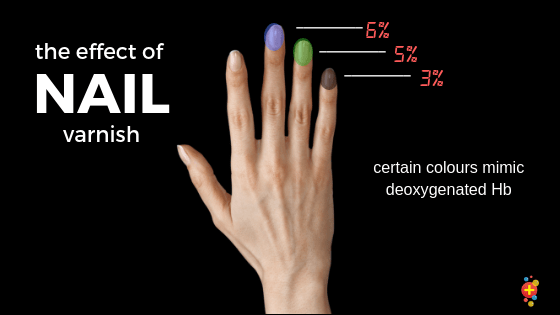
Hopefully, our younger patients are not wearing nail varnish, but I have seen many acrylic nails in adolescents. There is conflicting evidence surrounding the impact of nail varnish. It depends on the colour. Some data suggests that varnish with an absorbance similar to deoxygenated blood (around 660nm) might lead to an artificial lowering of the reading. The studies have been carried out on small patient cohorts, so there is significant room for error. Suffice it to say, if the patient in front of you has nail varnish on, take it off.
Skin Tone
Increasingly, multiple studies now show that SpO₂ readings are systematically less accurate in individuals with darker skin pigmentation. The predominant pattern found in most research is that pulse oximeters overestimate true arterial oxygen saturation (SaO₂) in patients with darker skin tones, leading to occult hypoxaemia – SpO₂ values that appear “normal” despite true hypoxia.
This is not a new discovery; a quick PubMed search will show papers dating back to the 1980s that first highlighted disparities, but the clinical significance has come into sharper focus in the last few years, with real clinical implications.
Why does this happen?
Melanin (pigmentation) in the skin can affect light absorption by the pulse oximeter, potentially systematically biasing readings. From physics, we know that the darker an object is, the more light waves or heat it absorbs. In the human context, theoretically, the more melanin (i.e., the darker the skin), the more light is absorbed, and therefore the more directly it affects oxygen readings measured via a pulse oximeter.
There are multiple key highlights from research:
Systematic overestimation of oxygenation: Studies show that SpO₂ readings from pulse oximeters tend to be higher than true SaO₂ in patients with darker skin, especially at lower saturation levels (hypoxia), increasing the risk of ‘occult hypoxaemia’ and leading clinicians to miss truly unwell patients.
Direct Clinical implications: Research studies (including large cohort data) link these inaccuracies to delays in recognition of hypoxaemia and potential disparities in care. This is a real concern in conditions where early oxygen delivery guides management (such as Sepsis and respiratory pathology, including asthma, VIW, and bronchiolitis), with real implications for emergency care.
Device variability: The magnitude and direction of bias vary by device manufacturer, the population studied, device calibration and the clinical context. Some recent prospective data suggest that pulse oximetry bias patterns can be complex, with both under- and overestimation seen across different settings, but consistently greater relative errors remain in darker-skinned patient groups.
Diagnostic accuracy study in UK: A large UK NHS COVID-oximetry @home diagnostic accuracy study (11,018 paired measurements) showed that SpO₂ readings tended to be 0.6–1.5 % higher for people with darker skin than lighter skin at the same SaO₂, with higher false negative rates (SpO₂ appears “normal” despite true hypoxaemia) in darker skin categories.
The most recent November 2025 update of the NICE guideline on Suspected Sepsis in Under 16s (NG254) now explicitly mentions limitations in SpO₂ accuracy. The guideline notes that pulse oximeters may overestimate oxygen saturation, especially in those with darker skin pigmentation, and that this could mask true hypoxaemia. [6]
This is a significant step, as it marks one of the first times a UK national guideline has explicitly incorporated equity concerns in monitoring technology into mainstream emergency care guidance for paediatric sepsis.
Practice caution: acknowledge this important patient cohort and be aware if your patient is dark-skinned a “normal” SpO2 might not always be accurate and representative of their true SaO2 [1]
Integrate clinical context: Never review the SpO₂ in isolation; always consider work of breathing, perfusion, respiratory rate, and vital signs. Monitor trends rather than reacting to single SpO₂ values with consideration for the wider clinical picture and the patient in front of you.
Confirm when uncertain: If the child is clinically unwell, but SpO₂ appears “acceptable”, but the child is not clinically improving, it would be prudent to consider a CBG/VBG or enhanced monitoring.
Pulse oximetry will always be and continues to be a valuable tool in Paediatric care, but a growing body of evidence shows that its accuracy is not uniform across all skin tones and therefore our diverse patient cohort. UK clinical practice, including the NICE paediatric sepsis guidance, now acknowledges these limitations.
As paediatricians, we must integrate careful clinical assessment with an honest understanding of the limitations of our monitoring tools, such as the humble pulse oximeter. Doing so is essential if we are to deliver truly equitable, high-quality care and avoid perpetuating the health inequalities that already exist for the children and families we serve.
What about detecting hypoventilation?
It’s interesting, isn’t it, that we place an oxygen saturation probe on our soon-to-be sedated patients and then pop on supplemental oxygen. Whilst this is much more common in the adult environment, it still does occur in paediatrics. A lovely two-phase study by Fu et al. showed the expected rise in ETCO2 and PaCO2 with post-operative hypoventilation. In the second phase of the experiment, the ‘volunteers’ were randomised to breathe room air or supplemental oxygen. They found that when a patient spontaneously breathed room air (FiO2 = 0.21), they could not hypoventilate to a PaCO2 > 70 mmHg without their SpO2 dropping below 90%. If they even had a trickle of oxygen (FiO2 = 0.25) their PaCO2 could rise to around 100 mmHg without a drop in oxygen saturation. Pulse oximetry should not be used as the sole means of detecting hypoventilation, especially when supplemental oxygen is being used.
Children can have tiny fingers, so where can you put the probes?
Incorrectly placed probes have caused blisters. Recently, the NHS Improvement body sent a Patient Safety Alert, citing the risks of harm from incorrect placement. Adult probes on children can produce falsely reassuring readings. Site-specific probes – fingers, toes, ears, and forehead should be used.
What’s the future?
Do you have a portable Sats probe in your pocket? There is a good chance you do but didn’t know it. With most of the medical workforce owning a smartphone, you might be surprised that you can use it for something more than catching up on the latest tweets from @DFTBteam. There are camera-based apps that use the strobing flash and camera lens to determine heart rate and oxygen saturation. Some probes can plug directly into the phone, though these are much more costly than the app-based option.
Selected references
Alexander CM, Teller LE, Gross JB. Principles of pulse oximetry: theoretical and practical considerations. Anesthesia & Analgesia. 1989 Mar 1;68(3):368-76.
Aoyagi T. Pulse oximetry: its invention, theory, and future. Journal of anesthesia. 2003 Nov 1;17(4):259-66.
Barker SJ, Shah NK. The effects of motion on the performance of pulse oximeters in volunteers (revised publication). Anesthesiology: The Journal of the American Society of Anesthesiologists. 1997 Jan 1;86(1):101-8.
Brand TM, Brand ME, Jay GD. Enamel nail polish does not interfere with pulse oximetry among normoxic volunteers. Journal of clinical monitoring and computing. 2002 Feb 1;17(2):93-6.
Chan ED, Chan MM, Chan MM. Pulse oximetry: understanding its basic principles facilitates appreciation of its limitations. Respiratory medicine. 2013 Jun 1;107(6):789-99.
Coté CJ, Goldstein EA, Fuchsman WH, Hoaglin DC. The effect of nail polish on pulse oximetry. Anesthesia and analgesia. 1988 Jul;67(7):683-6.
Cotton SA, Lee JA, Malhotra A, McGuire WC. Do Differences in Skin Pigmentation Affect Detection of Hypoxemia by Pulse Oximetry: A Systematic Review of the Literature. Clin Nurs Res. 2025 Nov;34(8):403-411. doi: 10.1177/10547738251374746. Epub 2025 Oct 4. PMID: 41045137; PMCID: PMC12723707.
Fu ES, Downs JB, Schweiger JW, Miguel RV, Smith RA. Supplemental oxygen impairs detection of hypoventilation by pulse oximetry. Chest. 2004 Nov 1;126(5):1552-8.
Hay WW, Brockway JM, Eyzaguirre M. Neonatal pulse oximetry: accuracy and reliability. Pediatrics. 1989 May 1;83(5):717-22.
Jamali H, Castillo LT, Morgan CC, Coult J, Muhammad JL, Osobamiro OO, Parsons EC, Adamson R. Racial Disparity in Oxygen Saturation Measurements by Pulse Oximetry: Evidence and Implications. Ann Am Thorac Soc. 2022 Dec;19(12):1951-1964. doi: 10.1513/AnnalsATS.202203-270CME. PMID: 36166259.
Hendrickson, Carolyn M., et al. “EquiOx: A Prospective study of pulse oximeter bias and skin pigmentation in critically-ill adults.” medRxiv (2025): 2025-1
Martin DS, Doidge JC, Gould D, Shahid T, Cowden A, Charles WN, Francis Johnson A, Garrett R, Mbema C, Olusanya O, Healy E, Rowan K, Mouncey P, Harrison DA; EXAKT Study Investigators. The impact of skin tone on performance of pulse oximeters used by NHS England COVID Oximetry @home scheme: measurement and diagnostic accuracy study. BMJ. 2026 Jan 14;392:e085535. doi: 10.1136/bmj-2025-085535. PMID: 41534914; PMCID: PMC12801414.
National Institute for Health and Care Excellence. Suspected sepsis in under 16s: recognition, diagnosis and early management [Internet]. London: NICE; 2025 Nov 19 (NICE guideline; no. NG254). Available from: https://www.nice.org.uk/guidance/ng254
Paterson E, Sanderson PM, Paterson NA, Loeb RG. Effectiveness of enhanced pulse oximetry sonifications for conveying oxygen saturation ranges: a laboratory comparison of five auditory displays. BJA: British Journal of Anaesthesia. 2017 Oct 13;119(6):1224-30.
Ralston AC, Webb RK, Runciman WB. Potential errors in pulse oximetry III: effects of interference, dyes, dyshaemoglobins and other pigments. Anaesthesia. 1991 Apr;46(4):291-5.
Rubin AS. Nail polish color can affect pulse oximeter saturation. Anesthesiology: The Journal of the American Society of Anesthesiologists. 1988 May 1;68(5):825-.
Salyer JW. Neonatal and pediatric pulse oximetry. Respiratory care. 2003 Apr 1;48(4):386-98.
Severinghaus JW, Honda Y. History of blood gas analysis. VII. Pulse oximetry. Journal of clinical monitoring. 1987 Apr 1;3(2):135-8.
Sinex JE. Pulse oximetry: principles and limitations. The American journal of emergency medicine. 1999 Jan 1;17(1):59-66.
Tomlinson S, Behrmann S, Cranford J, Louie M, Hashikawa A. Accuracy of Smartphone-Based Pulse Oximetry Compared with Hospital-Grade Pulse Oximetry in Healthy Children. Telemedicine and e-Health. 2018 Jul 1;24(7):527-35.
Van Gastel M, Stuijk S, De Haan G. Camera-based pulse-oximetry-validated risks and opportunities from theoretical analysis. Biomedical Optics Express. 2018 Jan 1;9(1):102-19.
https://www.sleepequityproject.org/pulse-oximetry-bias-for-skintone
Would love to know more of your thoughts on the use of pulse oximeters by parents and lower scope of practice/lay healthcare workers. Updated Patient Safety Alert link here; https://improvement.nhs.uk/documents/3603/Patient_Safety_Alert_-_Placement_of_oximetry_probes_FINAL.pdf
I cannot see many reasons for the home use of pulse oximeters. There is enough data out there suggesting that continuous pulse ox is not useful in bronchiolitis, for example, and may cause more harm than good (and not just in terms of pressure sores). I have the same issue with baby monitors. They often seem to cause more anxiety than anything else.
Bonafide, C.P., Xiao, R., Brady, P.W., Landrigan, C.P., Brent, C., Wolk, C.B., Bettencourt, A.P., McLeod, L., Barg, F., Beidas, R.S. and Schondelmeyer, A., 2020. Prevalence of continuous pulse oximetry monitoring in hospitalized children with bronchiolitis not requiring supplemental oxygen. __Jama__, __323__(15), pp.1467-1477.